Solar Street Lighting Trends 2026: 5 Key Changes for Distributors and Contractors
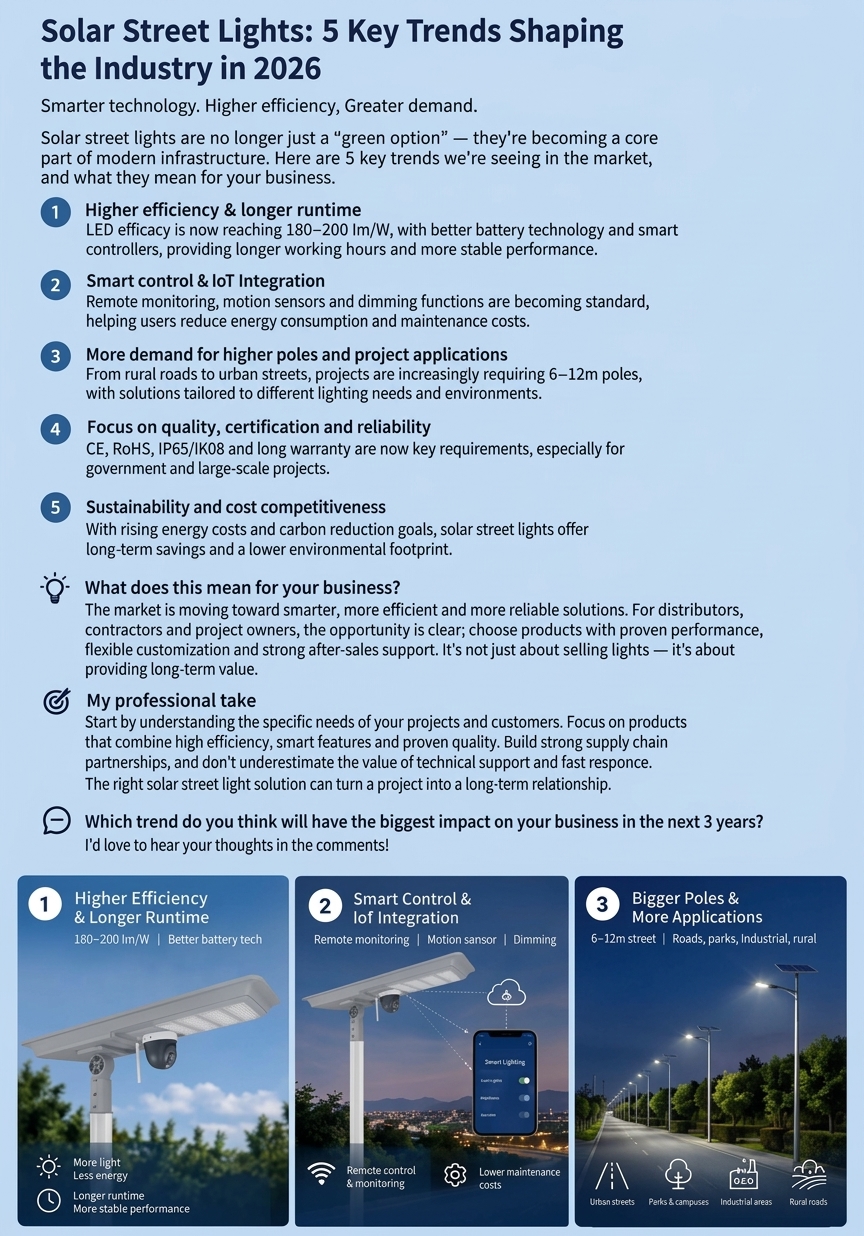
The solar street lighting trends in 2026 show a clear shift from simply buying higher-wattage products toward choosing complete, application-specific lighting solutions.
For distributors, contractors, importers and project developers, purchasing decisions are no longer based only on the wattage or unit price of a solar street light.
Professional buyers are paying more attention to LED efficiency, battery runtime, solar panel sizing, smart control, system reliability, application suitability and total project cost.
This means the key question is changing from:
“How many watts is the solar street light?”
to:
“Can the complete solar street light system deliver the required illumination and runtime for this specific project?”
Based on our experience working with solar lighting distributors and project customers, here are five solar street lighting trends worth watching in 2026.
Higher Efficiency and Longer Runtime
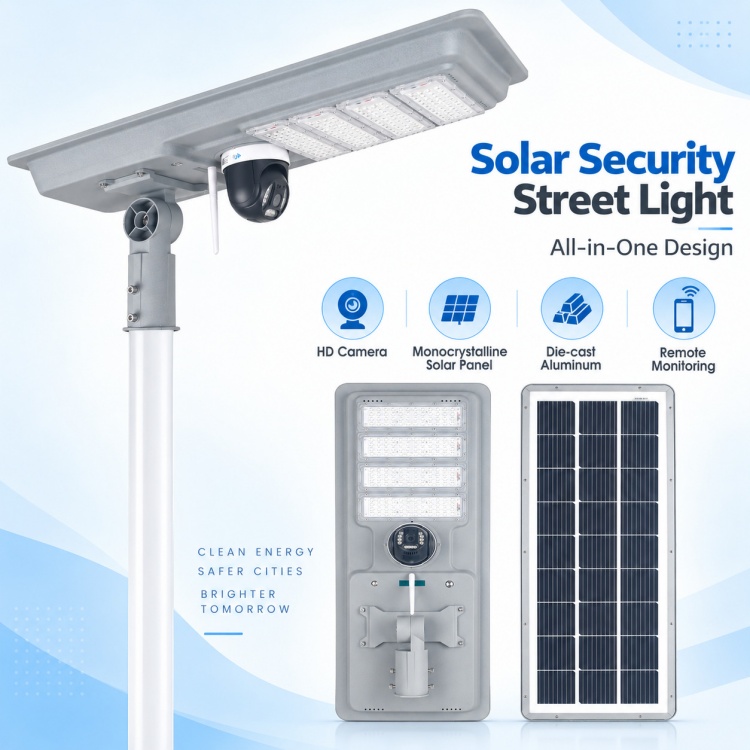
One of the most important solar street lighting trends is the increasing focus on system efficiency rather than wattage alone.
Buyers are paying closer attention to:
- LED luminous efficiency
- Optical efficiency and light distribution
- Battery capacity and battery quality
- Solar panel wattage
- MPPT charging efficiency
- Actual nighttime runtime
- Backup days
- Programmable lighting schedules and dimming
A higher-wattage lamp does not automatically provide a better solar street lighting solution.
For example, a properly designed 30W or 40W solar street light may be more suitable for a 3–4 meter installation than an oversized 60W or 80W product.
The correct wattage depends on the actual application.
Pole height, road width, spacing, required illuminance, LED efficiency, optics and operating schedule all affect how much power is actually required.
This is why evaluating the complete solar street light system is becoming more important than comparing wattage numbers on specification sheets.
[Internal Link: Link “solar street light system” or “solar street lights” to your main Solar Street Light product/category page.]
Smart Solar Street Lighting and Remote Monitoring
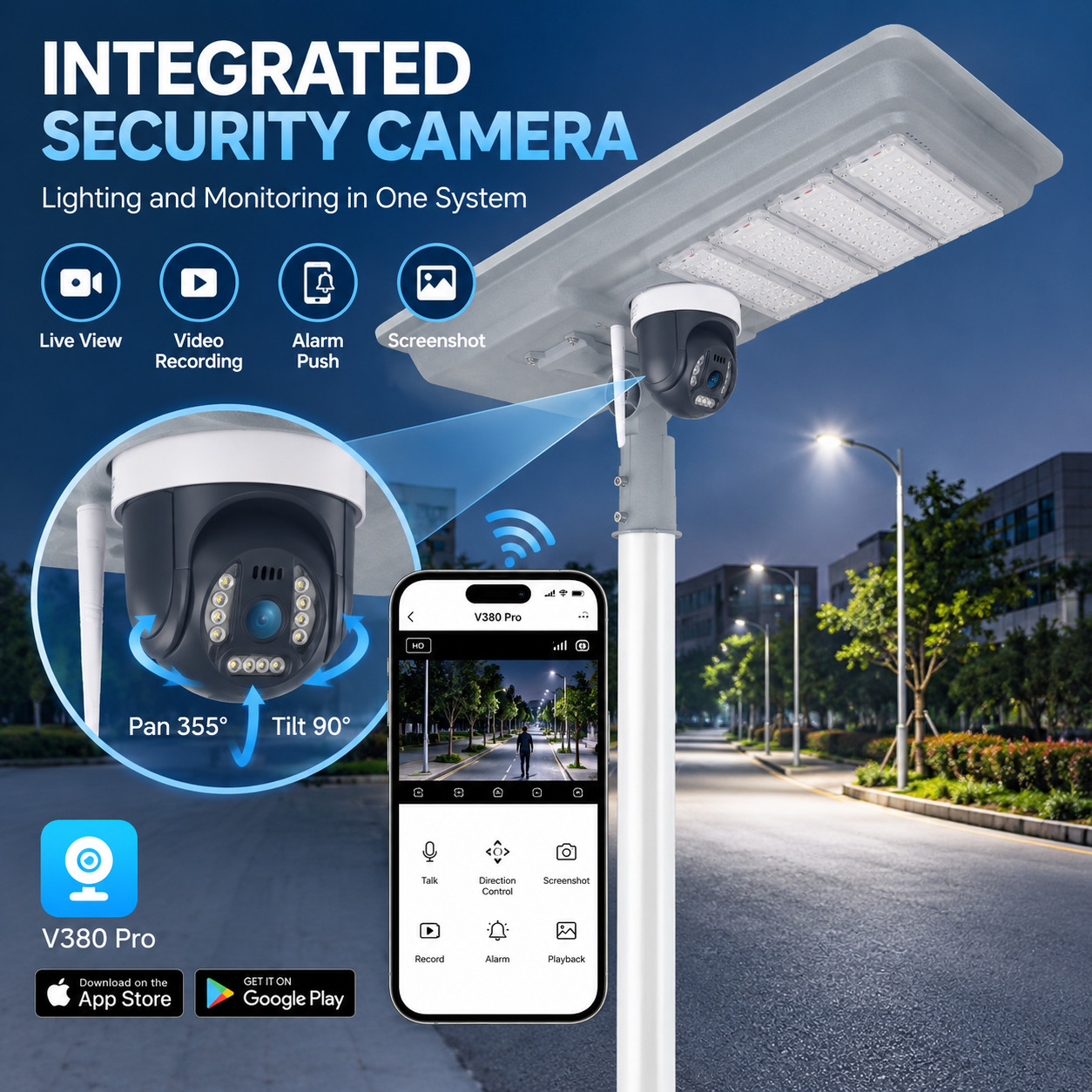
Another important development is the growth of smart solar street lighting.
As projects become larger and more sophisticated, some project owners are looking for better ways to control and monitor installed lighting systems.
Depending on the project, smart solar street lighting can include:
- Programmable dimming schedules
- Motion sensors
- Remote monitoring
- Battery status monitoring
- Solar charging information
- Fault alerts
- Individual lamp monitoring
- Centralized lighting management
For a small residential project, these functions may not always be necessary.
However, for larger infrastructure, municipal, industrial or commercial projects, remote monitoring can provide greater visibility into system performance after installation.
Instead of waiting for someone to report that a light is not working, a smart monitoring system may help operators identify abnormal conditions earlier.
Intelligent dimming can also help balance brightness, battery capacity and runtime.
For example, a solar street light does not necessarily need to operate at 100% output throughout the entire night.
A project might use a schedule such as:
100% → 70% → 50% → 30%
depending on traffic conditions and project requirements.
This can reduce unnecessary energy consumption and help optimize battery usage.
Solar Street Light Design Is Becoming More Application-Specific
There is no single solar street light configuration that fits every project.
A light installed on a 3–4 meter pole has very different requirements from a road lighting system installed at 8–12 meters.
This is why professional solar street light project design should begin with the application rather than the wattage.
Important project information includes:
- Pole height
- Road width
- Pole spacing
- Required lux level
- Traffic conditions
- Installation location
- Local solar radiation
- Rainy or cloudy days
- Required backup days
- Operating hours per night
- Dimming requirements
For example, two customers may both ask for a 60W solar street light, but their actual requirements could be completely different.
One project may involve a 6-meter residential road with narrow spacing.
Another may involve an 8-meter roadway with wider spacing and higher illumination requirements.
Using exactly the same solar panel, battery, optics and lighting schedule for both projects may not produce the best result.
A more professional approach is to start with the project conditions and then determine the appropriate combination of:
LED power + luminous efficiency + optics + solar panel + battery + controller + lighting schedule.
For larger projects, lighting simulation and photometric data such as IES files can also help evaluate light distribution before installation.
[Internal Link: Link “solar street light project” to one of your completed project/case study pages.]
Reliability Is Becoming a Key Purchasing Factor
Reliability has always mattered, but it is becoming increasingly important as solar street lights are used in larger commercial, infrastructure and government projects.
For distributors and contractors, product failures do not only mean replacing a lamp.
They may also mean:
- Additional site visits
- Labor costs
- Transportation costs
- Replacement parts
- Customer complaints
- Project delays
- Damage to the distributor’s or contractor’s reputation
This is why professional buyers are looking more closely at the components inside a solar street light.
Important factors include:
- LiFePO4 battery quality
- Battery cycle life
- MPPT controller performance
- LED efficiency
- PCB and electronic components
- Surge and electrical protection
- Waterproof design
- IP rating
- IK rating
- Thermal management
- Housing materials
- Certifications
- Warranty
- After-sales support
Outdoor lighting products must operate under heat, rain, dust, humidity and temperature changes for years.
Therefore, evaluating only the initial purchase price can give an incomplete picture of the real product cost.
For distributors especially, stable product quality can help reduce future warranty and after-sales costs.
[Internal Link: Link a relevant phrase here to your Quality Control, About Us, Warranty or Manufacturing page.]
Total Cost of Ownership Is Becoming More Important
Price remains an important factor in the solar lighting business.
However, another important solar street lighting trend is the increasing attention paid to Total Cost of Ownership (TCO).
The cheapest solar street light at the purchasing stage may not always be the lowest-cost solution over several years of operation.
A low-cost product may eventually require:
- More frequent battery replacement
- More maintenance
- More site visits
- More spare parts
- Higher labor costs
- Earlier complete product replacement
Consider a project with hundreds of solar street lights.
Even a relatively small failure rate can create significant maintenance costs when technicians need to travel to multiple installation sites.
For remote projects, the cost of reaching the installation location may sometimes be greater than the cost of the replacement component itself.
A properly designed system may therefore provide better long-term value through higher efficiency, stable battery performance, reliable components and easier maintenance.
This is why TCO can be a useful consideration when comparing solar street lighting solutions.
What Do These Solar Street Lighting Trends Mean for Distributors?
The market is gradually moving from product selling toward solution selling.
In the past, a typical inquiry might have been:
“Please quote your 30W, 60W and 100W solar street lights.”
Today, more professional project discussions start with questions such as:
“What pole height are you using?”
“How wide is the road?”
“What lux level do you need?”
“How many hours should the light operate each night?”
“How many rainy days should the system support?”
For solar lighting distributors, this creates an opportunity to build product ranges around applications, rather than simply offering a catalogue of different wattages.
For example:
- Residential roads
- Rural roads
- Parking areas
- Parks and pathways
- Industrial areas
- Perimeter security
- Municipal roads
- Off-grid infrastructure projects
This approach can also make it easier for distributors to recommend the correct solar street light solution to their customers.
What Should Contractors Consider When Choosing Solar Street Lights?
Before selecting a solar street light for a project, contractors should collect the basic project information first.
At minimum, consider:
1. Installation height
Higher poles generally require different lumen output and optical distribution.
2. Road width and pole spacing
These affect light distribution and illumination uniformity.
3. Required illumination
A residential pathway and a main road have very different lighting requirements.
4. Local solar conditions
Solar radiation and weather conditions influence solar panel and battery sizing.
5. Required backup time
Projects requiring several cloudy or rainy days of backup may need greater battery and solar panel capacity.
6. Nighttime operating schedule
Running at full output for 12 hours requires considerably more energy than using a carefully designed dimming schedule.
7. Maintenance requirements
For remote or difficult-to-access installations, reliability and ease of maintenance become particularly important.
The goal should not simply be to select the highest wattage.
The goal is to design a balanced solar street lighting system that meets the actual project requirements.
Frequently Asked Questions About Solar Street Lighting
What are the main solar street lighting trends in 2026?
Major solar street lighting trends include higher system efficiency, smarter controls, application-specific design, greater attention to reliability and increased focus on total cost of ownership.
Professional buyers are increasingly evaluating the complete system instead of comparing products based only on wattage and price.
Is a higher-wattage solar street light always better?
No.
The correct wattage depends on pole height, road width, spacing, required illumination, LED efficiency, optics and operating schedule.
An oversized system may increase cost without providing meaningful additional value for the application.
How do I choose the right solar street light for a project?
Start by identifying the pole height, road width, pole spacing, required illumination, installation location, operating hours and required backup days.
The solar panel, battery, LED power, optics and controller can then be selected around those project requirements.
What battery is commonly used in solar street lights?
LiFePO4 batteries are widely used in modern solar street lighting systems because of their cycle life, safety characteristics and suitability for repeated charging and discharging.
However, battery capacity alone should not determine system quality. Cell quality, BMS design, temperature performance and charging strategy should also be considered.
What is smart solar street lighting?
Smart solar street lighting combines solar-powered lighting with functions such as programmable dimming, motion sensing, remote monitoring, fault reporting or centralized management.
The required level of intelligence depends on the size and requirements of the project.
How many backup days should a solar street light have?
There is no single number suitable for every location.
Required backup time should be determined according to local weather conditions, solar radiation, project requirements and acceptable lighting performance during consecutive cloudy or rainy days.
From Solar Street Light Products to Solar Lighting Solutions
The solar street lighting trends in 2026 point toward a more engineering-driven market.
Wattage and unit price will remain important, but they are only part of the purchasing decision.
For distributors, contractors and project developers, the performance of a solar street light ultimately depends on how well its individual components work together.
The right combination of LED efficiency, optics, battery capacity, solar panel sizing, MPPT controller, lighting schedule and mechanical design can have a much greater impact on project performance than simply increasing wattage.
At Yistar Lighting, we work with distributors, contractors and project customers to evaluate solar lighting requirements based on actual applications, including pole height, road width, operating time and project conditions.
For a new solar street lighting project, providing the basic project information first can make it easier to determine a suitable system configuration.