Solar Street Lights Market Trends: 5 Key Changes Shaping the Industry in 2026
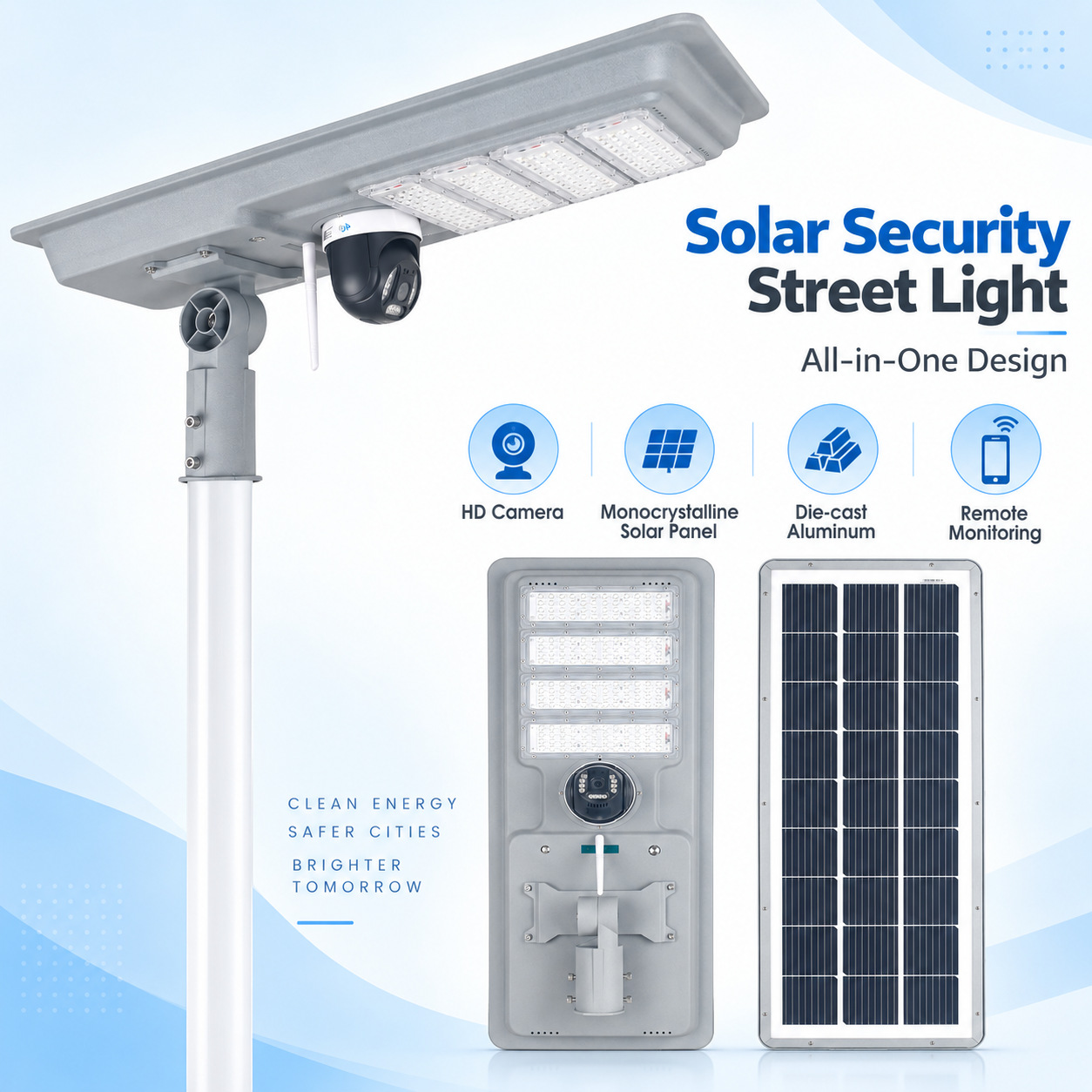
The solar street light market is changing.
For distributors, contractors, importers and project developers, buying decisions are no longer based simply on the wattage or unit price of a solar street light.
Customers are increasingly looking at efficiency, runtime, reliability, smart control, application suitability and total project cost.
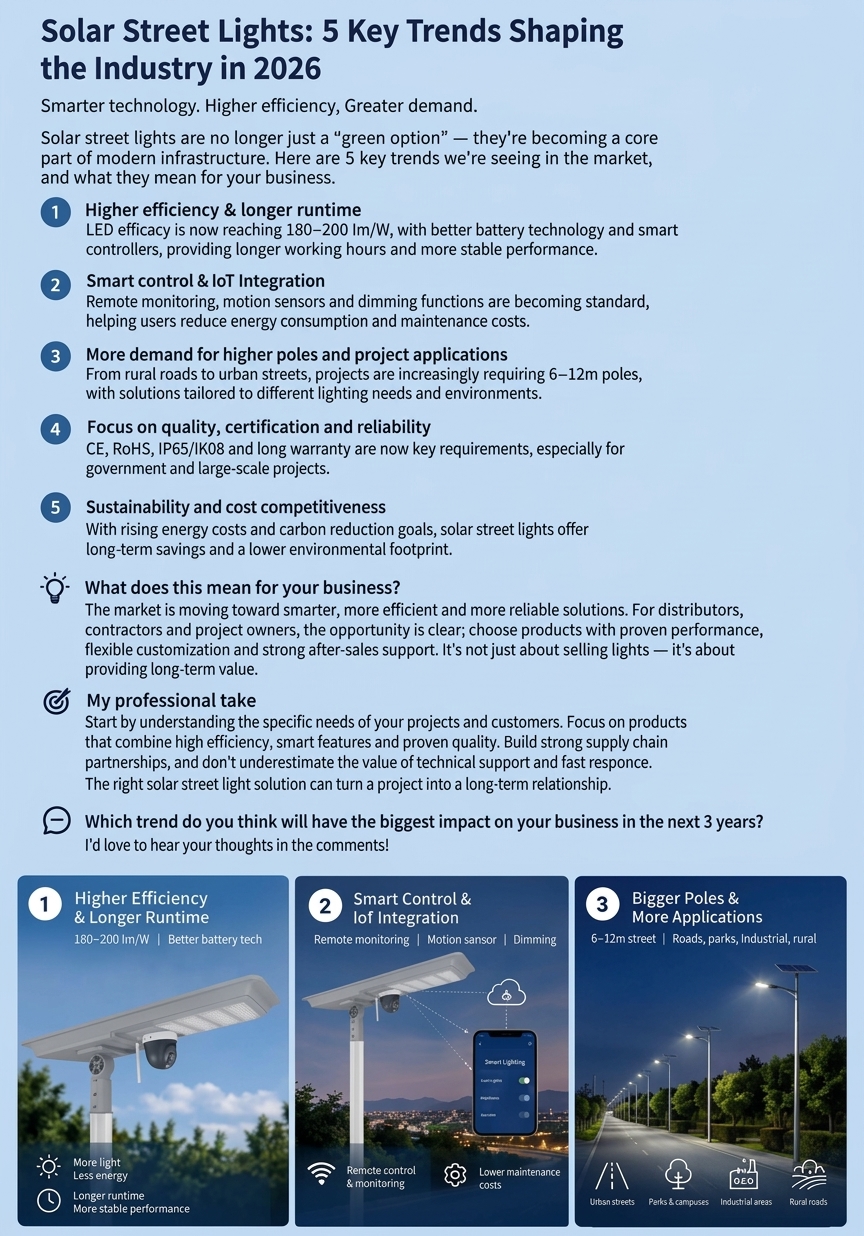
Based on our experience working with solar lighting distributors and project customers, here are five trends worth watching in 2026.
Solar Street Lights Higher Efficiency and Longer Runtime
One of the biggest changes in solar street lighting is the increasing focus on system efficiency.
Buyers are paying closer attention to:
- LED luminous efficiency
- Optical performance
- Battery capacity and quality
- Solar panel sizing
- MPPT charging efficiency
- Actual nighttime runtime
- Lighting schedules and dimming
A higher-wattage lamp does not automatically mean a better solar street light solution.
For example, a well-designed 30W or 40W solar street light can be more suitable for a low-height road than an oversized 60W or 80W product.
The key question is no longer simply:
“How many watts is the lamp?”
It is:
“How much useful light can the complete system deliver, and for how long?”
Smart Control and Remote Monitoring Are Becoming More Important
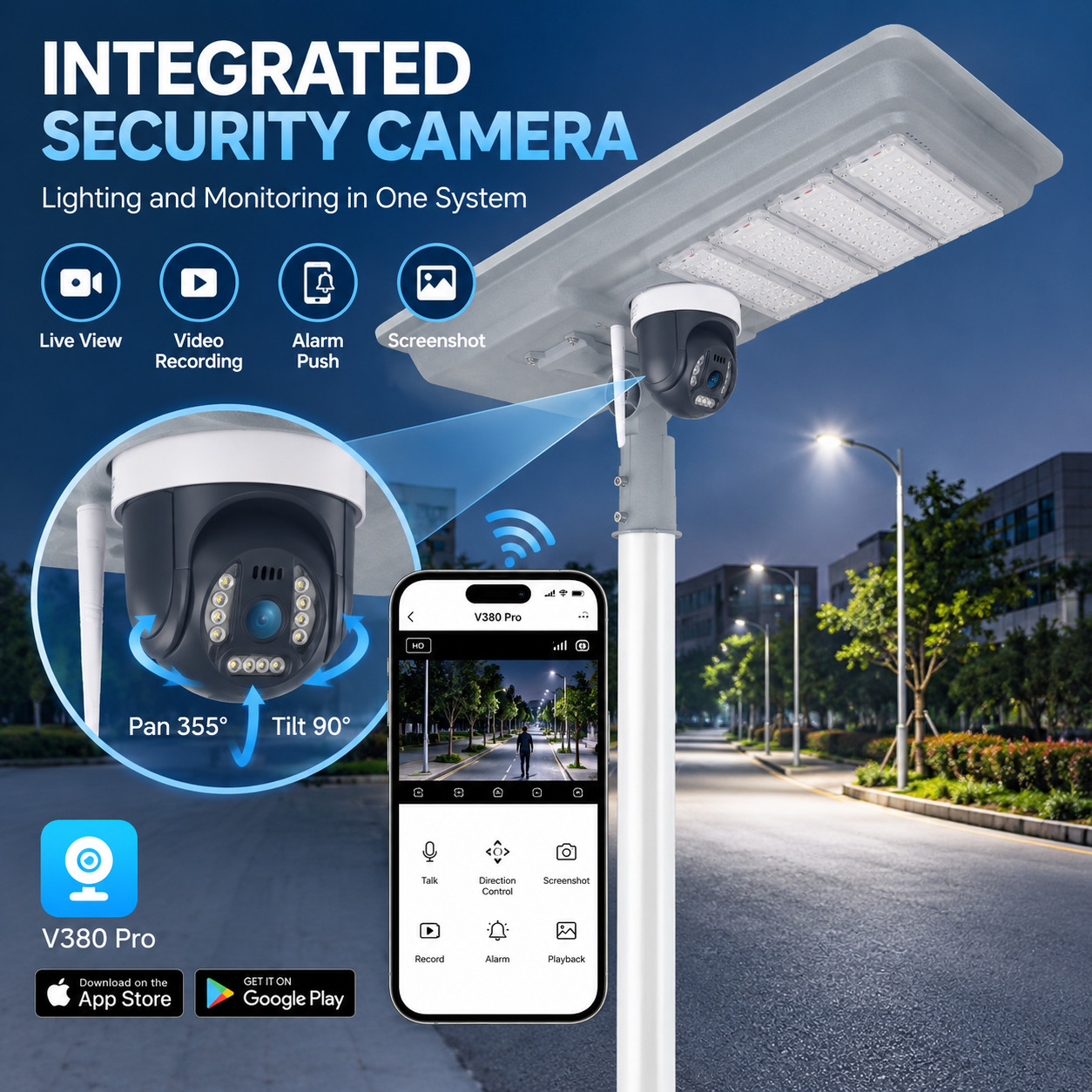
As solar lighting projects become larger and more sophisticated, intelligent control is gaining attention.
Depending on the application, customers may require:
- Programmable dimming schedules
- Motion sensors
- Remote monitoring
- Battery status monitoring
- Fault alerts
- Centralized control
These functions can help project owners understand how their lighting systems are performing and potentially reduce unnecessary energy consumption and maintenance costs.
For larger infrastructure projects, smart control can also provide better visibility after installation.
Solar Street Lights Are Becoming More Application-Specific
There is no single solar street light configuration that fits every project.
A solar street light installed on a 3–4 meter pole has very different requirements from one installed on an 8–12 meter road lighting pole.
Factors such as:
- Pole height
- Road width
- Pole spacing
- Required illumination
- Local weather conditions
- Daily sunlight hours
- Required backup days
- Traffic and pedestrian activity
all influence the correct system design.
This is why we are seeing more customers move away from simply asking for “50W solar street lights” and instead asking for a complete lighting solution based on the actual project conditions.
Reliability and Product Quality Are Becoming Key Purchasing Factors
For distributors and project contractors, product reliability can directly affect their reputation and after-sales costs.
This is particularly important for government projects, infrastructure projects and large-scale installations where replacing hundreds of lights can be expensive and time-consuming.
Buyers are therefore paying more attention to:
- Battery quality
- MPPT controller performance
- LED and driver components
- Surge protection
- Waterproofing
- IP and IK ratings
- Certifications
- Thermal management
- Warranty and after-sales support
A solar street light is expected to operate outdoors for years.
The real value of a product should therefore be considered over its entire operating life, rather than only its purchase price.
Total Cost of Ownership Is Becoming More Important
Price is still important in the solar lighting business.
But increasingly, professional buyers are looking beyond the initial unit price.
A cheaper product may become more expensive if it requires:
- More frequent battery replacement
- Higher maintenance
- More site visits
- More spare parts
- Earlier product replacement
On the other hand, a properly designed system may provide better long-term value through improved efficiency, reliability and easier maintenance.
This is why Total Cost of Ownership (TCO) is becoming an increasingly useful way to evaluate solar street lighting projects.
What Does This Mean for Solar Lighting Distributors and Contractors?
The market is moving from product selling to solution selling.
Instead of asking only:
“What is your cheapest solar street light?”
More buyers are asking:
“Which solar street light is suitable for my project?”
For distributors, this creates an opportunity to build a stronger product range around different applications rather than offering only different wattages.
For contractors and project developers, it means that the correct product selection should start with the project requirements.
The right combination of LED efficiency, optics, battery, solar panel, MPPT controller, lighting schedule and mechanical design can have a much greater impact on project performance than simply increasing the lamp wattage.
Our View: Design the System Around the Application
At Yistar Lighting, we believe solar street lighting should start with the application, not the product catalogue.
Before selecting a model, we recommend looking at:
Pole height → Road conditions → Required lighting level → Spacing → Working hours → Local sunlight → Backup days → Battery and solar panel capacity
Only after these factors are understood can the appropriate solar street light configuration be selected.
For distributors, this approach can also help reduce product mismatches and after-sales problems while creating more value for end customers.
The future of solar street lighting is not simply about higher wattage or higher efficiency.
It is about designing a more efficient, reliable and application-specific lighting system.
And for businesses in the solar lighting industry, that shift creates opportunities for better products, better technical support and stronger long-term customer relationships.
Are your customers still mainly comparing solar street lights by wattage and price — or are they starting to ask more about system performance and total project cost?